


Interview with an award winner
TCAA 2026-2028
yang02
 Photo: SHA Hiroyasu
Print: TERAYA Nobuyasu (GRAIN HOUSE)
Profile of yang02 is available here
Looking back on your career so far, is there anything influencing your current creative work?
I studied in the Art and Media Course of the Department of Information Design
at Tama Art University.
I’d originally wanted to enter the Department of Graphic Design but I ended up enrolling in the
Department of Information Design. It was a place to study media art, or in other words art and not
design. I happened to be taught by the two professors of Kubota Akihiro and Mikami Seiko and I think
what I learned from them had a huge influence on me.
This is because I feel that I was instilled with ideas that were both self-referential and
self-critical while using media and technology. That’s how I think that I became able to develop
critical thinking skills. Having built up my career so far, that point is frequently evaluated and
if
I trace it back to its beginnings I strongly feel that the notion works should be created with that
kind of attitude is something I learned at university.
In particular, Professor Kubota told me: “Don’t create content, make mechanisms and frameworks themselves. Create work that questions the very core of things.” The origins of my own creative work lie in graffiti, and I naturally came to ponder on the question of why graffiti needs to be drawn by humans in the first place. That’s why I created a device that draws graffiti. Through this kind of artistic practice, I have been questioning and examining various issues—for example, what it means to appreciate at the works produced and the very foundations of art and fine art, which presuppose human existence.
As I learned in that sort of environment, I have created my work with an awareness of implementing the pieces via engineering in both the software and hardware. Technology is both a medium and a form of media, and for me it is the means of expression. Against this backdrop, particularly over the past few years, I have become increasingly aware, through my own use of technology, of how deeply contemporary society and human existence are shaped by it. People’s sense of distance from technology is changing rapidly, and I’ve come to see technology as politics itself. That realization has brought me to where I am today.
-
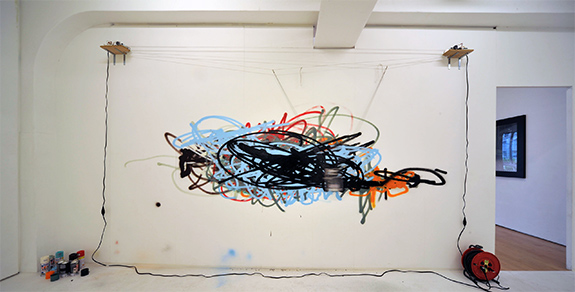
A Device for “Graffiti,” 2011, installation view at “Tokyo Story 2010,” Tokyo Wonder Site Hongo, 2011
-
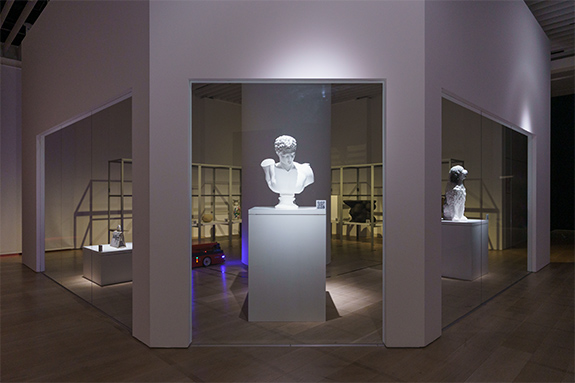
Installation in Progress, 2022, installation view at “Roppongi Crossing 2022:Coming & Going,” Mori Art Museum, Tokyo Photo: TAKEHISA Naoki
About TCAA screening
Actually, a member of the Selection Committee have approached me about being nominated before. At the time, however, my career as an artist was in exactly its tenth year and I had never been described as a “mid-career artist,” so I thought it was a bit too early, and in the end withdrew. To be honest I did feel a twinge of regret, but I also strongly felt that eventually my time would come and I visited every TCAA Exhibition. This time I set my sights on the award and thought “now is the time!” TCAA has been a competition I've had on my mind ever since 2019.
I made a great deal of preparation for the final screening, so I was really
nervous before the
beginning. But when it started the atmosphere was really relaxed and felt quite homely, surprisingly
enough. Also, I approached it with the mindset that I would be quite happy if I could have a good
discussion with the selection committee members about the things that interest me, and achieving
that
would be enough regardless of whether I was selected or not. I felt that I had been able to express
myself well during the final Q&A session. I sensed that what I do and my awareness of issues
resonated
with overseas curators, giving us something in common to talk about. I came away with a strong sense
that I had been able to confirm that connection.
I was really delighted when I was informed that I had been given the award, because I think there
are
a lot of mid-career artists and it is a difficult competition with only two people winning the
award.
On my social media profile I had half-jokingly described myself as a “mid-career artist in my
prime,”
and now that had become true, or at least a feeling rose up in me that I really was
“mid-career.”
-
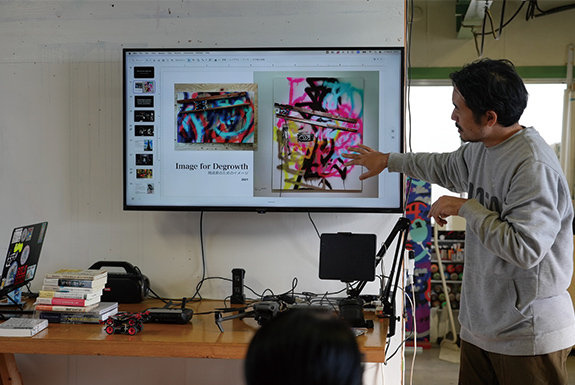
Scene from the selection presentation
During the first year after receiving the award, you will receive support for activities overseas. What kind of overseas activities are you planning?
There are two main themes I want to deal with.
One is an energy problem, namely nuclear power, with which I have long had an interest in. When
people
say “nuclear power” what usually comes to mind is nuclear fission, but what I am interested in is
“nuclear fusion,” often referred to as the energy of the future. Ms. Lesley Ma, a member of the
International Selection Committee, also referred to it as “post-nuclear” in her video message
for
the
Symposium. Power generation using fusion has not yet been commercialized and is still at the
research stage, and I want to research about new energy techniques and technology in general.
Specifically, I would like to participate in a tour of the world’s largest tokamak-type experimental nuclear fusion facility, currently under construction at the International Thermonuclear Experimental Reactor (ITER) in the south of France. In addition, I want to visit the Max Planck Institute for Plasma Physics (IPP), a nuclear fusion facility in Munich. These are places I’ve long wanted to visit but have never had the money or time to do so, and I am planning to take this opportunity for activities overseas to go around them all.
Japan itself has a lot of nuclear power stations. There’s usually a visitor
center near a nuclear
power plant where you can find out about the mechanism of nuclear power generation, and a display of
materials. I’ve already been to Aomori to see the Mutsu Science Museum, and the Rokkasho Visitors
Center, which introduces the nuclear fuel cycle facilities in Rokkasho Village. In particular, at
the
Mutsu Science Museum they exhibit the reactor removed from the nuclear-powered ship “Mutsu” in its
original state. It is the only exhibit of its kind in the world and is quite unusual. I was able to
see a reactor that had actually once been in operation.
I am interested in nuclear fission as a reaction in itself. Atoms exist on an invisible scale of
about
one hundred-millionth of a centimeter, and when it comes to nuclear fission, it seems to involve
heavy
atoms, although this is something I can hardly imagine. The fission reactions of relatively heavy
atoms release energy that can be used for bombs or for running power stations, but I find myself
wondering what is actually happening in those nuclear reactions. I am fascinated by the fact that
something happening on a scale of one hundred-millionth of a centimeter can have consequences
powerful
enough to shake the world.
The other theme that intrigues me is technology related to the military and
weapons. Military
technology is usually dual-use, and the greatest of these is atomic power. What started out as an
atomic bomb was switched to the generation of electric power, and so on. The drones I used during my
recent exhibition “Flying Organs” at BUG in 2026 were quadcopters with four rotors. Originally sold
for civilian use, they are now being used as weapons on the frontline of battlefields. Quadcopter
drones are currently being mass produced as weapons.
The drones used from the outset of Russia’s invasion of Ukraine were manufactured and sold by a
company in Shenzhen, China. Recently, the development of humanoids and so on is also booming, and
linked with AI their introduction to the battlefield is occurring in a seamless way.
I think that by visiting the cutting edge of technology in Shenzhen, China, particularly in fields like physical AI, where advances are moving at a pace that overtakes the USA, and by finding out what sort of issues are arising there, I will be able to obtain images and ideas for my artworks.
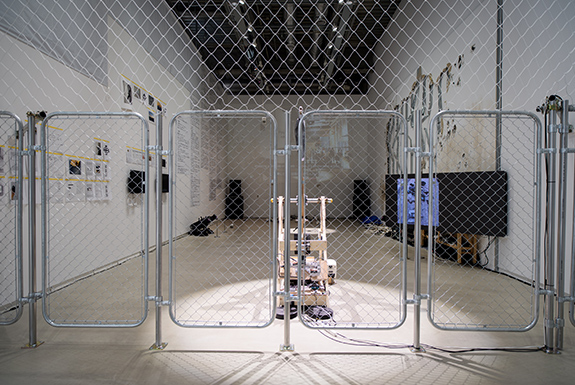
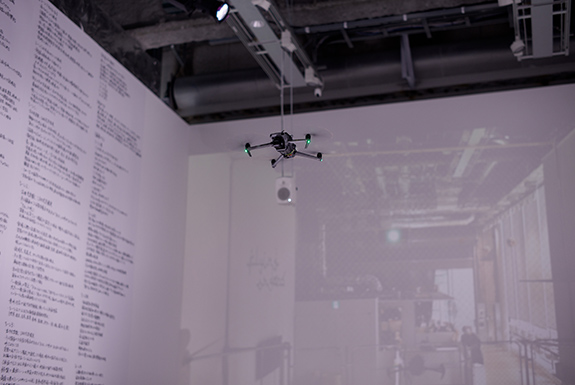
Installation view at “Flying Organs,” BUG, Tokyo, 2026 Photo: TAKEHISA Naoki
As of June 2026, could you tell us about your current ideas for next year’s exhibition?
I think that I have always doubted things that appear clear-cut, rather than taking them for granted. Members of the International Selection Committee also said similar things, so I think I will proceed self-consciously with a renewed sense of that point. While on one hand nuclear power and energy problems are universal, I think that our recognition of them is actually quite vague. In response to that, I want to present “technology” itself in its raw, exposed form, and somehow draw out a sense of tactility and reality. The same applies to the issue of technology in warfare and military affairs. In the sense that Japan is not currently involved in a war, this is not an issue that many Japanese feel any familiarity with, but there are armed conflicts in many places in the world. Although some people do protest, for the vast majority of Japanese, it is seen as something in the far distance. However, in these places of conflict, the latest technology is being used and breakthroughs in innovation are occurring. Even though many people have some sort of shallow understanding of this, their awareness is wrapped up in the convenience of their own daily lives and it is difficult for them to look at the negative aspects of technology. I feel that I have to make artworks that make people aware of this reality to the greatest possible extent.
At the end of the and Symposium, Ms. Kondo Yuki, a member of the International Selection Committee, mentioned “blindness” as being a common feature in the work of me and Mr. Han Ishu. Han said something like the body's blindness toward the world as a whole. Regarding my work, she pointed out that instead of taking for granted the things that seem perfectly ordinary or self-evident—the kind of things people tend to overlook in everyday life—I identify the "blind spots" within them and turn those into works of art. I felt that was exactly right. Unlike the previous award exhibition featuring Umeda and Oh I don’t think Han and I will be exhibiting in exactly the same space. However, as we exhibit together, I’d like us to work toward a shared understanding.
Video Documentation: SHA Hiroyasu
Sound: YOKOYAMA Kengo
Text Edited by Tokyo Arts and Space